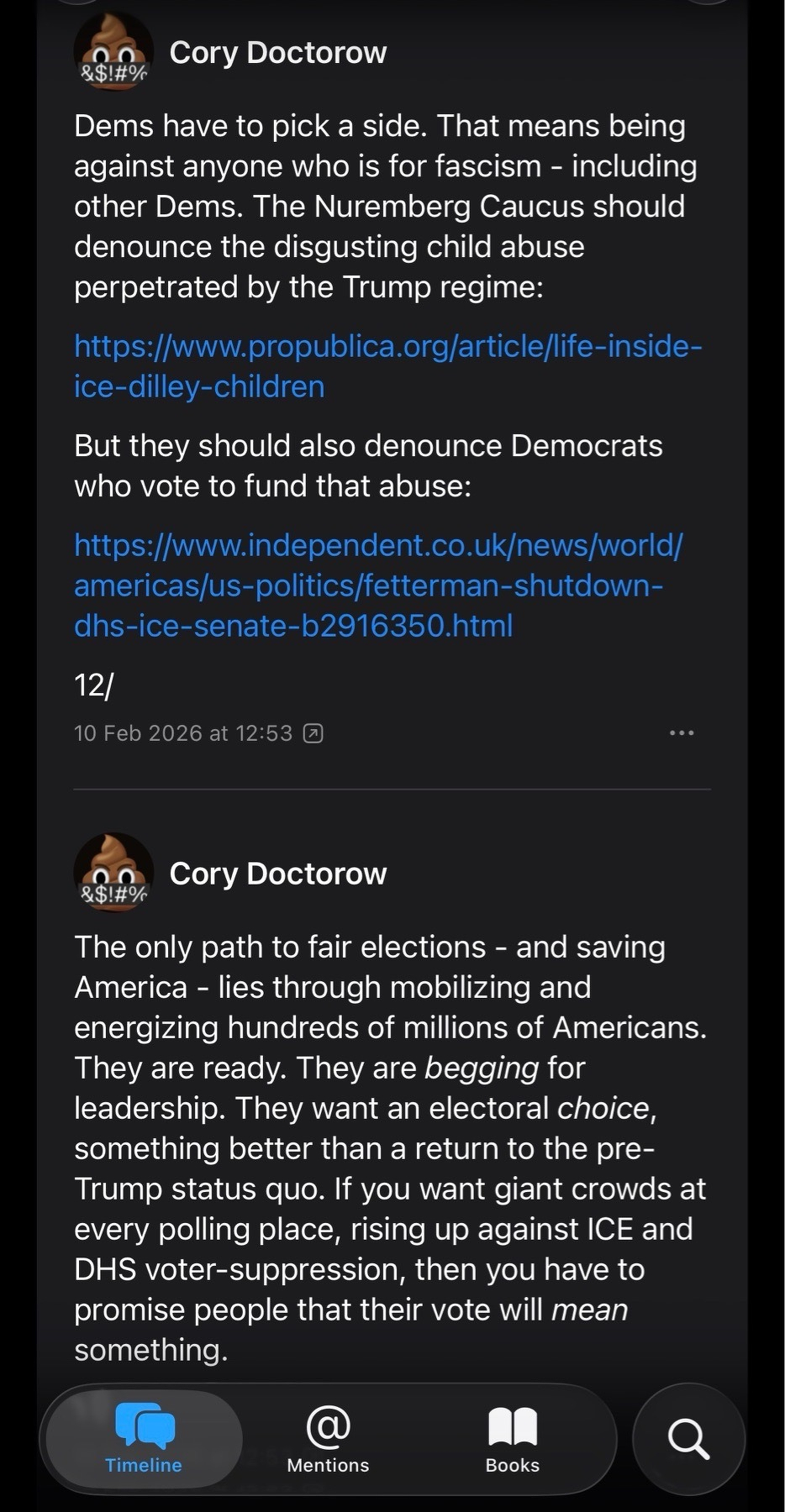

I like what Cory Doctorow posts on here a lot. I agree with his prescriptions to the problems a lot too. However, what’s lacking is context regarding why these solutions may not come to fruition.
It’s hard to call a government that allows participation from only two parties a democracy.
What we have now resembles what the French term “démocrature” describes. According to Wikipedia (translated), this term is a blend of seemingly contradictory concepts. Démocrature refers to a political regime that, despite having a democratic electoral system, operates more like a dictatorship, often suppressing the rule of law. Essentially, it is a facade of democracy.
This concept is frequently used to describe countries that maintain the formal appearance of democratic institutions while being governed by a small group or individual, often in undemocratic ways.
The United States legislature does not follow the will of its people they follow the will of business. This isn’t conjecture, it’s supported by facts. If you understand how politics in Washington DC works, you know that money moves policy.
Historically, this has been a consistent pattern. Significant changes to exploitative business practices often followed violent protests. Workers' rights, as we know them today, were secured through sacrifice and struggle. Peaceful protests alone have seldom been enough to alter the harsh realities imposed by the ruling class. From the French Revolution to the Haymarket Riots to the Civil Rights Movement, violence has frequently preceded meaningful change.
In the last 40 years, voting has not significantly impacted income inequality or wage growth. Given this track record, it’s a tall order to expect people to have faith in a system that has repeatedly let them down.